Happy Friday, and welcome to Food Fix. It’s somehow already October, and the Halloween decorations are in full swing here!
Food Fix in NYT: I was quoted in the New York Times this week in an article by Sheryl Gay Stolberg about the MAHA Summit. As I noted, the lack of press access to the summit (which featured several U.S. government officials) made little sense.
New American Dish: This week, we’ve got a great media roundtable with Liz Essley Whyte from the Wall Street Journal, Chelsea Cirruzzo with STAT and Marcia Brown with Politico. We talked about MAHA and the midterms, recent big stories in the news, and what we’re all watching this fall. Listen here or watch on YouTube.
Don’t miss out: If you work in the food space and you’re not already getting Food Fix twice a week, you are missing out! Upgrade today.
As always, I welcome your feedback. Send me your thoughts by replying to this email, or drop me a line: helena@foodfix.co.
Alright, let’s get to it –
Helena
***
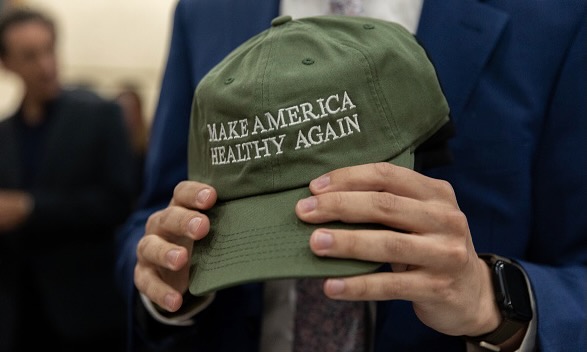
Democrats home in on MAHA amid MAGA tensions
In late July, when Rep. Alexandria Ocasio-Cortez (D-N.Y.) mentioned on a podcast that she had been meeting with MAHA activists, it made some heads turn.
AOC is widely considered a leading 2028 presidential contender for Democrats and is also seen as politically savvy. She’s certainly more online and tuned into the zeitgeist than many of her colleagues. During an interview on the Majority Report, AOC told Emma Vigeland she thinks MAHA played a pivotal role in the 2024 election.
“I actually meet with MAHA activists,” Ocasio-Cortez said. “I work with MAHA advocates because a lot of them really don’t believe their fight is partisan. And it’s not, in many ways. We do have extraordinary corruption in our agricultural system, in our big corporate system as well. This is an area where both parties and our entire political system has been compromised.”
Politico reported earlier this month that these meetings have been quite extensive: “Behind the scenes, AOC’s team began a monthslong outreach effort in the spring, bringing the New York Democrat face-to-face with MAHA leaders,” reported Will Steakin.
The report noted that Ocasio-Cortez “still has significant differences with the broader MAHA movement” including on topics like criticizing vaccines, but there’s plenty of other topics she agrees with – pesticides, PFAS regulation and access to healthy food, to name a few. Someone close to AOC described the meetings to Politico as a chance to listen and “brainstorm” about how the two sides might “build a movement together” around their shared priorities.
Courting MAHA: AOC’s approach, it should be noted, is different from many other Democrats who see going anywhere near MAHA as a tacit endorsement for the Trump administration’s anti-vax rhetoric, at best – or, at worst, aligning themselves with anything the Trump administration has done, whether it’s historic cuts to Medicaid and SNAP, gutting biomedical research, or making deep staffing cuts at CDC and FDA, the list goes on and on. For many Democrats, it’s just a bridge too far.
Still, in the past few weeks, we’ve seen more signs that some Democrats are trying to figure out how to appeal to MAHA voters who are disappointed with the Trump administration’s lack of action on their key issues.
As I wrote earlier this week, there’s been a lot of criticism of the corporate sponsors backing the MAHA Summit that was held in Washington on Tuesday. The high-dollar sponsors included a long list of pharma and health care companies, and well-known names like Anthropic, OpenAI and Walmart. It was all rather jarring for a movement built on concerns about corporate capture. The backlash to the summit sponsorships only furthers the idea that there’s a real opening here for new political alliances.
MAHA on the campaign trail: In Michigan, Democratic Senate candidate Abdul El-Sayed this week unveiled a “Building a Healthier America” platform clearly aimed at MAHA-aligned voters. The plan backs ideas like stricter regulation of microplastics and PFAS in water, expanded scratch cooking in schools and greater anti-trust enforcement in agriculture.
“Through my time as a public health doctor, I’ve seen the catastrophic consequences of our country’s food safety crisis up close,” he said in a statement. “Corporations care more about their bottom line than the health of their consumers.”
El-Sayed, who has held various health official roles in Michigan, including leading county and city health departments, has been careful to note that he supports vaccines.
“I will always be evidence-driven when it comes to vaccines,” El-Sayed told CBS News this week. “But the key thing is that you want to know that what you’re feeding your kids and what you’re putting in the body is pure.”
We don’t know how the midterms will turn out – El-Sayed, for one, is locked in a tight race, though some polls show him leading Republican Mike Rogers. But House Democrats are reportedly getting their ducks in a row in case they take the House, which they are currently favored to do.
MAHA memo: In an 84-page memo to House Minority Leader Hakeem Jeffries this week, lawmakers propose “reclaiming MAHA” as one of their potential health care priorities (among many other things).
“Americans’ concerns about chronic disease and food safety, especially that which is linked to corporate influence over environmental regulation and public health, are legitimate and long overdue for a serious legislative response,” the memo reads. “Seventy-five percent of Americans want stricter food additive rules and 64 percent want stricter pesticide rules. Another survey found that 76 percent of Americans in battleground districts believe that banning cancer-causing chemicals in food would improve Americans’ health.”
The memo floats a ton of potential bills Democrats could pass in the first 100 hours and the first 100 days, on issues ranging from glyphosate (and other pesticide) liability to infant formula and baby food contaminant limits.
New caucus alert: Along these same lines, Rep. Chellie Pingree (D-Maine) is launching a new bipartisan “Fix Our Food” caucus in the House to try to get more engagement on these types of issues. I interviewed Pingree recently for American Dish (follow the podcast to get notified when it airs). She argued that Democrats just need to find the issues where they have common ground with MAHA and work on those. “We are always looking for bipartisan things that we can do because it might create a win,” she said.
Bottom line: Among all the political factors shaping the midterms, the fresh effort by Democrats to win over MAHA supporters – or a post-election focus on MAHA-aligned legislation, if the House or Senate flips – could have longer-lasting ramifications. I’ll be watching closely to see how all of this plays out.
***
What I’m reading
SNAP’s funding model is starting to change. Here’s what that means for the program. (NPR). “The Supplemental Nutrition Assistance Program is undergoing a drastic restructuring of its funding model – one that will reduce federal support and require states to shoulder a larger share of the bill,” Juliana Kim reports. “Historically, the federal government and states have evenly split the food aid program’s operational costs, such as paying for state workers and training staff. But starting on Thursday, states will need to cover 75% of that tab while federal funding shrinks by half. By the federal government’s own calculations, the new rule will lead to a $16.9 billion reduction in federal spending for SNAP over the next five years, or $3.4 billion annually.”
A ‘freaked out’ U.S. food industry is hitting back at MAHA – with social media influencers (The Guardian). “Some of the biggest food and agriculture corporations in the U.S. are funding a campaign that pays social media influencers to combat elements of Robert F. Kennedy Jr.’s Maha platform, according to an investigation by the Guardian and Documented, an investigative watchdog and journalism project,” report Rachel Leingang and Riley Messer. “Cross-partisan support in Washington on some of these issues poses a threat to the food industry’s bottom line – though the Trump administration has largely stopped short of enacting new regulations. But several large corporations are fighting back. An effort by the Center for Food Integrity, an industry-funded non-profit, tracks public sentiment around key issues central to Maha and suggests ways that agricultural interests can counter those narratives by appealing to emotion or scientific reasoning. They call it Gaha: Growing a Healthier America. Documents show the coordinated effort is tracking Maha closely and researching ways to respond to the movement’s claims without alienating its supporters.”
Rural MAHA followers say Trump hasn’t improved health of their communities (Associated Press/KFF Health News). “About half of rural voters identify with MAHA, a sprawling political movement championed by the Trump administration, but most said President Donald Trump’s healthcare policies have not benefited their communities, according to a new poll from The Associated Press in partnership with KFF,” Ali Swenson, Sarah Jane Tribble and Linley Sanders report. “About 8 in 10 rural voters – an important voting bloc for Trump and fellow Republicans – said the Trump administration’s policies have had a negative effect or no impact on the health of people where they live. Most MAHA supporters, 68%, also feel this way. The findings signal an apparent disconnect between the Trump administration’s MAHA-branded policy priorities and rural America’s perception of their reach and effectiveness.”
RFK Jr. just exposed a fraudster – and it is him (Washington Sun). “The British comedian Russell Brand will face trial in London in two weeks on multiple charges of rape, sexual assault and indecent assault against several women years ago,” writes columnist Dana Milbank. “But first, allies of Health Secretary Robert F. Kennedy thought it would be a good idea to invite Brand to moderate a panel at their ‘MAHA Summit’ in Washington yesterday, where he would vouch for the upstanding character of Kennedy and Mehmet Oz, the administrator of the Centers for Medicare and Medicaid Services. It went about as well as you’d expect. … ‘Say MAHA now!’ he told the crowd. … Brand then addressed the two men. ‘Your character cannot be questioned,’ he said. Oz, he gushed, is ‘a beautiful man’ and Kennedy ‘is devoted to what he does. … Thank you very much, Dr. Oz. Thank you, secretary. Love you.’ It was enough to Make America Heave Again. Even before Brand made his appearance, there was plenty of cause for queasiness at the MAHA Summit. The MAHA organizers had asked corporations to pay as much as $300,000 to sponsor the event. In exchange, Bloomberg News reported, they were offered ‘meaningful input on the panel composition and topic’ along with a private dinner for 30 guests with Kennedy and Oz.”
Bacteria is taking over the food pyramid (NPR). “How do you know what’s safe to eat? You don’t,” write Brittany Luse, Corey Antonio Rose, Neena Pathak. “And after a summer full of food recalls from lettuce to blueberries and even jalapeños, a regular trip to the grocery store can start to feel like a dangerous game. But how are the flaws in our food safety system creating issues beyond what we choose to grab in the produce aisle? To find out, Brittany is joined by Eric Schlosser, author of Fast Food Nation: The Dark Side of the All-American Meal.”
***
Why you should upgrade to a paid Food Fix subscription
Become a paid subscriber to unlock access to two newsletters each week, packed with insight, analysis and exclusive reporting on what’s happening in food, in Washington and beyond. You’ll also get full access to the Food Fix archive – a great way to get smart on all things food policy.
Expense it: Most paid subscribers expense their subscriptions through work. It’s worth asking!
Discounts: We also offer discounts for government, academia and students. See our subscription options. Individuals who participate in SNAP or other federal nutrition programs qualify for a free Food Fix subscription – just email info@foodfix.co.
Get the Friday newsletter: If someone forwarded you this email, sign yourself up for the free Friday edition of Food Fix. You can also follow Food Fix on X, Bluesky and LinkedIn.
See you again next week!