Happy Friday, and welcome to Food Fix. PSA for those of you that live in NYC: Forked is hosting a live podcast taping at the Brooklyn Museum with special guest Tom Colicchio on Nov. 4! We’ll talk about the restaurant biz, Colicchio’s experience lobbying on food issues, the MAHA movement and, of course, the midterm elections. Get your tickets.
Don’t miss out: If you work in the food space and you’re not already getting Food Fix twice a week, you are missing out! Upgrade today.
As always, I welcome your feedback. Send me your thoughts by replying to this email, or drop me a line: helena@foodfix.co.
Alright, let’s get to it –
Helena
***
Reflections on podcasting in the AI slop era
There’s a long-running joke in the media that we’re always pivoting to video.
I’m not sure exactly where the joke started, but I’d guess it was journalists making fun of management for thinking more video (vs. articles) would save us amid shrinking readership and flailing business models during the first wave of the social media era. (It won’t, and it hasn’t!)
In a way, poking fun at the whole pivot to video is gallows humor – the pivot almost always came with big layoffs. Some newsrooms have pivoted to video and then away from video only to now be pivoting back to video. It sounds ridiculous – and it is – but I think the current pivot to video is now actually becoming one of the dominant forces in media.
Video mania: By some estimates, consumers are now watching more than two hours of video per day – much of it via short-form clips on social media – and spending much less time with text across all platforms.
As someone who talks to humans, reads and writes words for a living, I dislike this pivot to video. It feels like we are compressing everything down to tiny snippets of performance (the ideal video length is something like 20 to 30 seconds). There’s no room for nuance. The algorithms need simplicity, and often rage, to get maximum engagement and attention – the ultimate currency.
I don’t like any of this. But the truth is, short-form video is increasingly how everyone is getting their news and, more broadly, their information on everything from politics to health and wellness. Media outlets are essentially all trying to pivot to video in some way or another.
As Brian Morrissey over at the Rebooting recently put it: “The emerging playbook is to embrace platform distribution – YouTube and Instagram are the new TV – as a top of the funnel play to reach new audiences and simply be relevant while drawing those audiences over time to owned platforms to develop direct relationships.”
Podcast pivot: How does a text-based journalist operate in this new short-form video world? A lot of us are experimenting. Some are getting on social media and talking to the masses on little mics like we’re influencers. Some are launching indy YouTube channels or making TikTok explainers about their reporting. The way I’m dabbling in short-form video is by clipping short videos from longer-form video podcasts.
I first started co-hosting Forked, a podcast by the Food & Environment Reporting Network, in April 2025, to dig into food politics in the news every two weeks. We publish short clips from those episodes on socials (like this one on a recent farm bill segment).
In March, Food Fix launched a new podcast called American Dish, where I interview the most influential people in food policy and get into some of the stories that don’t break through the news cycle. We publish short clips from the pod on Instagram and other platforms (even LinkedIn is pivoting to video).
Clip roulette: The hope is that people see a clip and go watch the full episode. Most people don’t do this, of course. (There’s a whole other conversation we could have about the clipping economy!) Still, playing the clip game is one way to help people ultimately find this newsletter and maybe even read it.
Human to human: Aside from feeding clips into the hungry algorithms, I love podcasting because it allows for more in-depth conservations and can sometimes deliver more insight than text alone.
This week on Forked, we have an interview with GOP rising star Rep. Kat Cammack (R-Fla.) where she laid out some of her thoughts about preemption and MAHA, as well as SNAP and the farm bill and the looming midterms. We also learned she has a lot of thoughts about infant formula and that she raises honeybees and chickens (but struggles to keep plants alive).
Last week, on American Dish, I hosted a panel discussion with Liz Essley Whyte from the Wall Street Journal, Chelsea Cirruzzo with STAT and Marcia Brown with Politico – all super smart reporters covering health and food policy in Washington. We talked about MAHA and the midterms, recent big stories in the news, and what we’re all watching this fall.
I’ve recently talked to food safety lawyer Bill Marler about cyclospora (and what keeps him up at night), chatted with Thrive Market co-founder and CEO Nick Green about the company’s push to get SNAP online, and dug into the cutting edge of food allergy research with Ilana Golant, founder and CEO of the Food Allergy Fund.
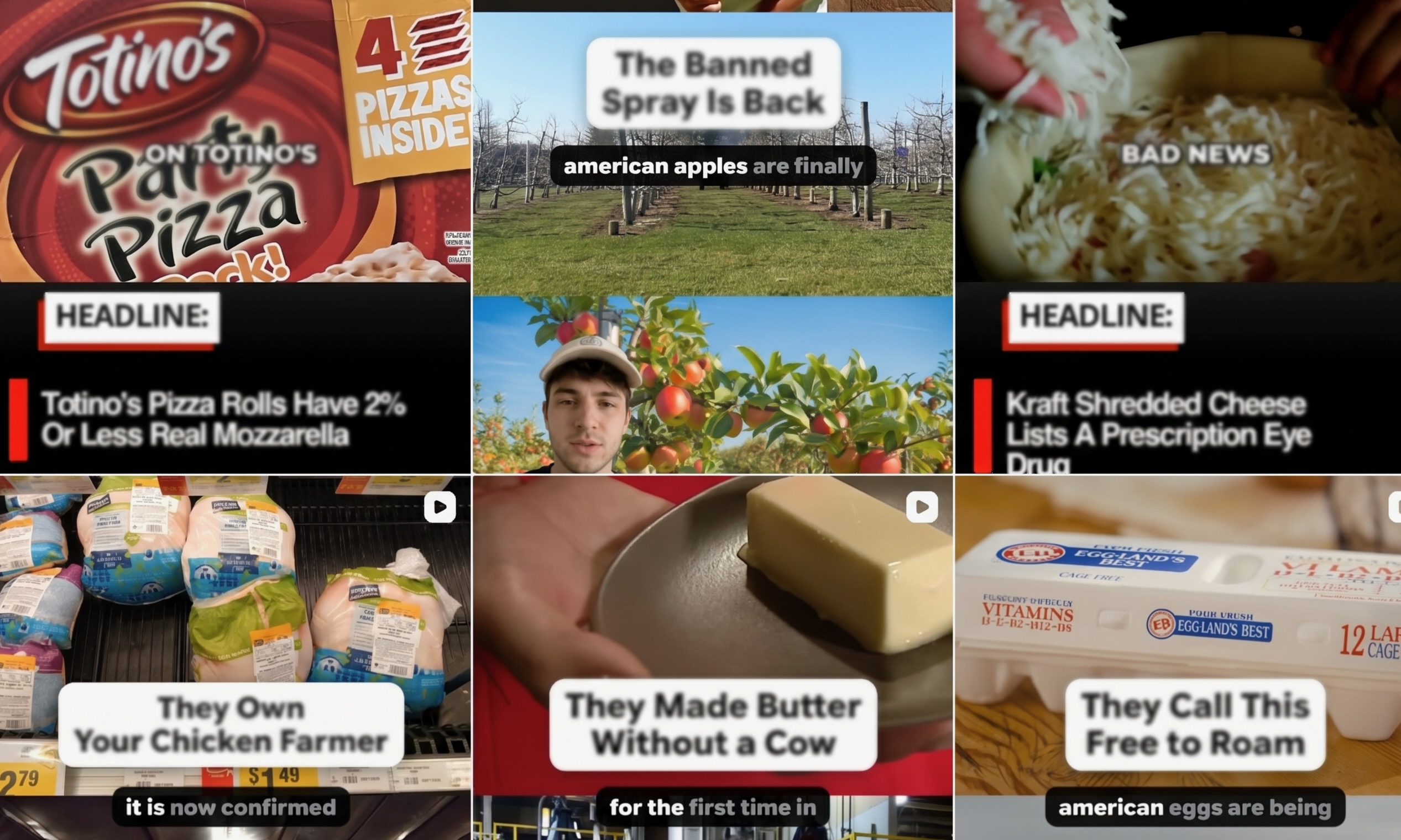
These are real, human conversations that you can hopefully learn something from. I think this type of medium is going to become even more important as our feeds are increasingly swamped with AI-generated content, AKA synthetic content or AI slop.
Synthetic slop: On Thursday, public health influencer Jessica Knurick (who has nearly 2 million followers on Instagram and also a PhD in nutrition science) lamented that it’s getting harder and harder to share facts amid this sea of slop.
“I’m deeply concerned about how AI-generated disinformation is going to distort our perception of reality,” Knurick wrote on Instagram. “Fighting inaccurate information on these platforms was always an uphill battle, but AI has made it feel nearly impossible.”
Knurick noted that a particular viral video falsely claiming Target and Walmart are selling lab-grown whole shell eggs had gained more than 6 million views. She said the account that shared the video has ties to Russia – great! Snopes did a fact-check on this egg claim back in August. It’s true that there are animal-free egg white proteins made with precision fermentation on the market, but these ingredients would appear in packaged foods (not shell eggs) and need to be labeled.
Zooming out: We’re only at the beginning of this AI content trend and it’s already becoming hard to spot, or to know what’s been verified and what hasn’t been. In the meantime, I recommend following humans and media outlets that you trust.
***
What I’m reading
FDA issues final rule on salt substitutes in standardized foods (FDA). “The U.S. Food and Drug Administration (FDA) has issued a final rule to permit the use of salt substitutes in foods with standards of identity (SOI) that specify salt (sodium chloride) as a required or optional ingredient. Today’s final rule gives manufacturers of foods subject to a SOI regulation the flexibility to reduce sodium, enabling innovation and the production of healthier standardized foods. Before today’s final rule, 139 SOIs allowed or required the addition of salt, but did not permit the use of salt substitutes in these foods. This meant manufacturers had few options to lower the sodium content in these standardized foods.”
Democrats plot a midterms push for MAHA voters (STAT). “Democrats are building bridges to a major new constituency: the MAHA voter,” reports Daniel Payne. “As the midterms near, leaders across the party have been meeting with MAHA activists, discussing potential openings with consultants, and rolling out food and environmental agendas meant to entice these voters. But the MAHA agenda Democrats are offering differs from that of health secretary Robert F. Kennedy Jr., the leader of the movement. Left-leaning candidates are focusing on food and disregarding one of Kennedy’s signature (if relatively fringe, according to pollsters) issues: vaccine injuries. In some ways, it’s a rebranding of long-held progressive ideals. Left-leaning candidates once espoused the MAHA principles of powerful government oversight in the food and medical system to rein in corporate power. Democrats believe enough MAHA voters want a change to join them, even without a focus on vaccines.”
MAHA loyalists accuse Trump administration of ‘broken promises’ (NBC News). “Some supporters of the ‘Make America Healthy Again’ movement have begun to publicly turn against their leader, Health Secretary Robert F. Kennedy Jr., and the Trump administration as a whole as they demand tougher crackdowns on food dyes and pesticides,” report Julie Tsirkin and Aria Bendix. “A scorecard released Thursday by MAHA activists, including former members of Kennedy’s 2024 presidential campaign, claims the Trump administration broke more than 85% of its promises to MAHA on food, agriculture and environmental health. The makers of the scorecard include Dave Murphy, a former fundraiser for Kennedy’s campaign, and Charles Eisenstein, Kennedy’s former chief speechwriter. NBC News is first to report on the scorecard, which offers a window into how MAHA views the administration, and Kennedy himself, ahead of the midterm elections. It accuses the Trump administration of doling out favors to the chemical industry, pointing to its decision to approve new pesticides and hire industry lobbyists and executives.”
SNAP, Crackle, Pop: Cuts won’t Make America Healthy Again (Medscape). “Roughly 36 million Americans were enrolled in the SNAP in June,” writes Vanessa M. Oddo in an opinion piece. “With funding and eligibility cuts to SNAP, at least 5 million people have lost assistance in the past year, with approximately 1.5 million of them being children. When asked last month whether he was concerned that the SNAP cuts would leave children and families with less access to food, HHS Secretary Robert F. Kennedy, Jr, said, ‘I don’t think it’s going to have that much effect.’ While Secretary Kennedy and the HHS tout their “MAHA” agenda to improve the American diet and lower chronic disease prevalence, they are simultaneously shrinking the program that is one of the main levers for doing so: SNAP. SNAP is the country’s largest nutrition safety-net, reaching approximately 42 million Americans with low-income per month, and is a key determinant of food insecurity. A rigorous study on the topic suggests that it lowers food insecurity by nearly 20%. That matters for health because food insecurity is associated with diet quality and chronic diseases, such as obesity, diabetes, hypertension, and heart disease – precisely the outcomes MAHA claims to target.”
The White House has unleashed Robert F. Kennedy Jr. (Washington Sun). “Consider Robert F. Kennedy Jr. unleashed. Muzzled earlier this year by White House officials uneasy with the health secretary’s fringier views, the Trump administration is now trying to leverage Kennedy and his Make America Healthy Again movement for Republicans ahead of the midterm elections,” report Paige Winfield Cunningham and Christa Dutton. “‘They’ve given him flexibility to be himself and do his Bobby Kennedy thing,’ one senior administration official told The Washington Sun. Earlier this year, rumors flew inside and outside the administration that Kennedy would be ousted after the midterms. Mehmet Oz, the administrator of the Centers for Medicare and Medicaid Services, was seen as a possible successor, according to multiple political and career staffers.”
***
Why you should upgrade to a paid subscription
Become a paid subscriber to unlock access to two newsletters each week, packed with insight, analysis and exclusive reporting on what’s happening in food, in Washington and beyond. You’ll also get full access to the Food Fix archive – a great way to get smart on all things food policy.
Expense it: Most paid subscribers expense their subscriptions through work. It’s worth asking!
Discounts: We also offer discounts for government, academia and students. See our subscription options. Individuals who participate in SNAP or other federal nutrition programs qualify for a free Food Fix subscription – just email info@foodfix.co.
Get the Friday newsletter: If someone forwarded you this email, sign yourself up for the free Friday edition of Food Fix. You can also follow Food Fix on X, Bluesky and LinkedIn.
See you again next week!